 English (UK)English (UK)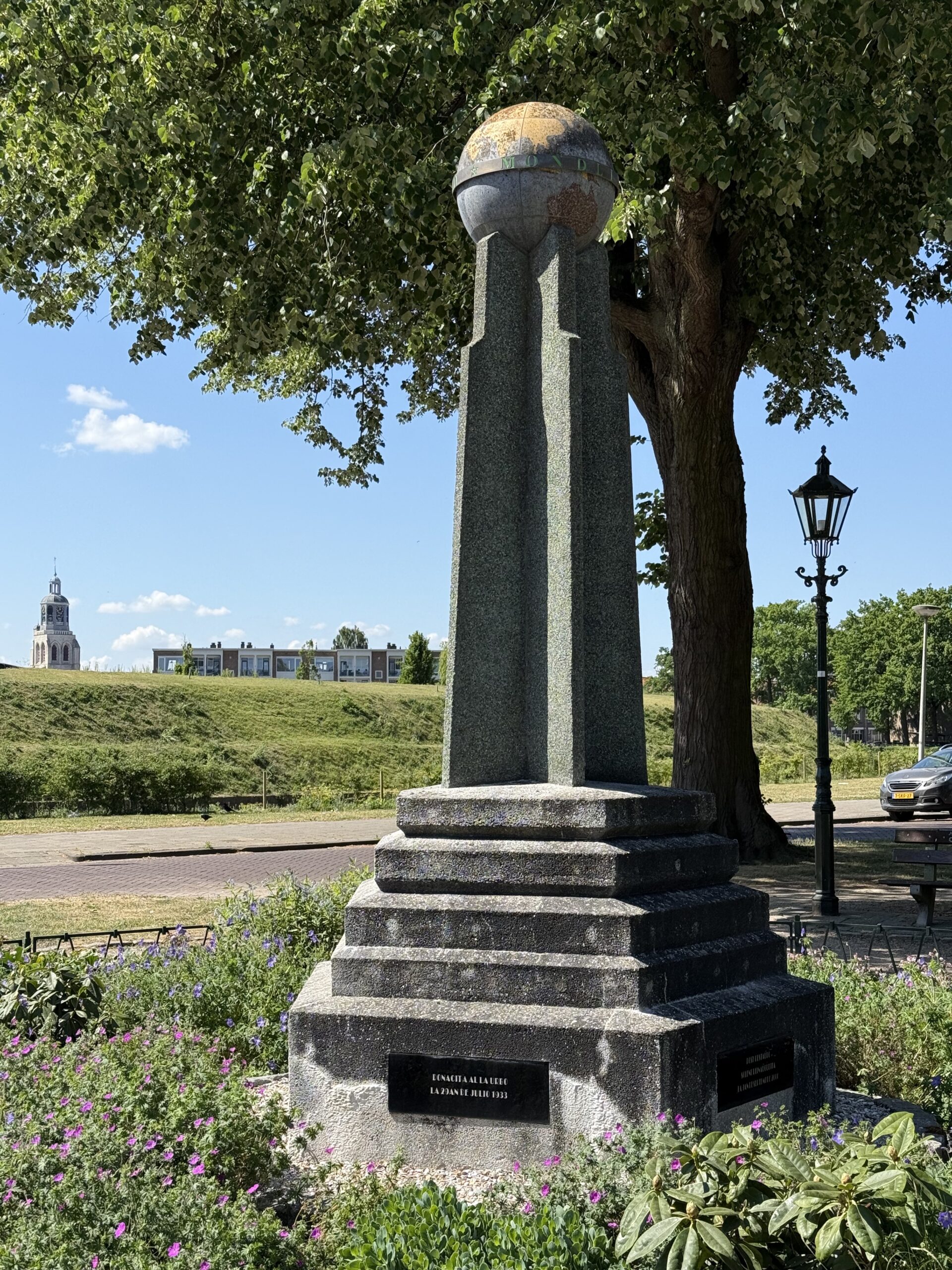
In 1926, the Roman Catholic Esperanto Study Circle was established by the Roman Catholic Military Association in Bergen op Zoom, under the name “Nia Katolika Idealo” (NKI). In July 1931, the idea arose within the NKI to realise a “Zamenhof Monument”. The design is by Mario Santuz, a “needle with a globe”.
Esperanto is intended as a new world language, developed by the visionary and idealistic Polish ophthalmologist, Ludwik Lejzer Zamenhof. His goal was to create a language that could serve as a second language worldwide, thereby facilitating communication between people of different native languages and promoting international peace and understanding. Zamenhof strongly believed that a common language barrier was a significant cause of conflicts and misunderstandings between nations.
At the festive unveiling of the monument in honour of Zamenhof, his daughter, Lidia Zamenhof, was in attendance. Lidia played a significant role in the promotion and dissemination of Esperanto across the globe. She was a linguist herself and was known for her skills as well as her passion for the idea her father had laid down. She emphasised how the language is not merely a tool for communication but also a symbol of unity, hope, and a shared future.
The monument itself is a work of art that symbolises the essence of Esperanto: a world united despite its diversity. A blend of culture and language is subtly interwoven into the design.
For more information about this image and the other images in our city, visit KidOR, Foundation for Art in Public Spaces.
The content is protected by copyright. Copying is not possible.
 Nederlands Nederlands English (UK)
 Deutsch
 Français