 English (UK)English (UK)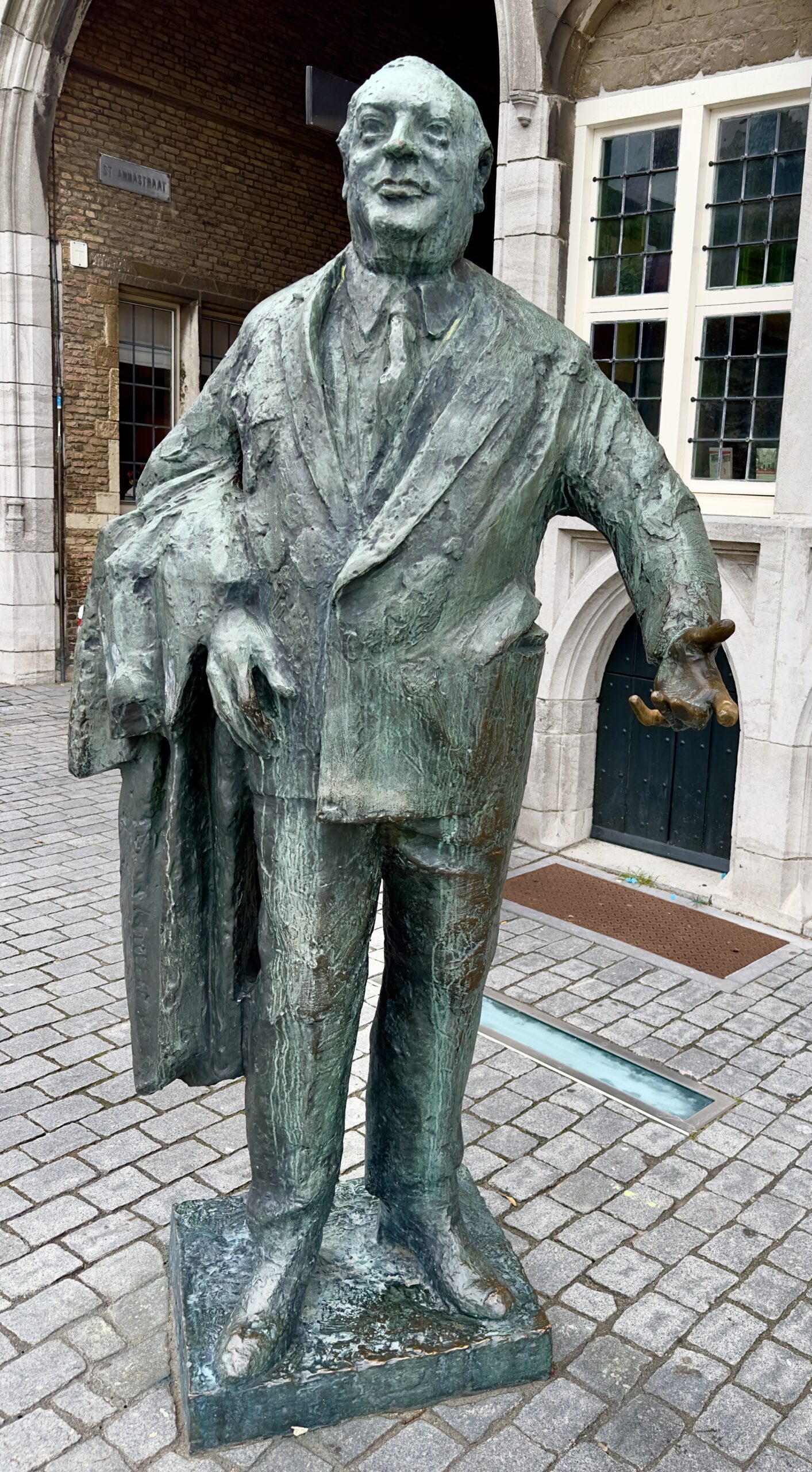
Anton van Duinkerken was a Dutch poet, essayist, critic, and professor. His real name was Willem Asselbergs, but he used the pseudonym Anton van Duinkerken for his literary works. He was born on 2 January 1903 in Bergen op Zoom and died on 27 July 1968 in Nijmegen.
Van Duinkerken was known for his versatile literary and intellectual activities. He was a prominent member of the literary movement “De Gemeenschap” (The Community), active in the 1920s and 1930s, which focused on Catholic literature and art. He wrote poems, essays, and critiques, often imbued with philosophical and religious undertones.
His connection to “Vastenavond” (Shrove Tuesday) is significant for Bergen op Zoom. The deep impressions he gained during the 1928 carnival in Bergen op Zoom led to his “Defence of Carnival,” written during the carnival on the night of Tuesday to Wednesday.
In addition to his literary work, Anton van Duinkerken was also involved in academic activities. He was a professor of Dutch literature at the Catholic University of Nijmegen (now Radboud University Nijmegen) and gave various lectures and presentations on literature and culture.
His literary work and intellectual contributions have had a lasting influence on Dutch literature and the cultural landscape. He has received multiple awards and recognitions for his work, including the Constantijn Huygens Prize.
Besides his literary work, Van Duinkerken was involved with the Catholic Radio Broadcasting (KRO) and the Katholieke Illustratie, where he worked as an editor. He wrote on various subjects, including religion, art, history, and politics, and was known for his clear and accessible writing style.
Before the Second World War, Van Duinkerken condemned National-Socialism and joined the so-called Comité van Waakzaamheid (Vigilance Committee). In 1942, he was interned in the hostage camp Sint-Michielsgestel. To distance himself from the pillarised political system, Van Duinkerken joined the Labour Party (PvdA) in 1946, which was an unprecedented step for a Catholic at the time. The bishops forbade Catholics from joining a socialist organisation. Nevertheless, Van Duinkerken remained loyal to his choices until his death. (With thanks to Publication KN, Friday 21 July 2023, number 29, Jeffry Huntjens, KDC).
Anton van Duinkerken is still remembered as a prominent figure in Dutch literary history, particularly for his contributions to the Catholic cultural heritage and his profound reflections on life, faith, and art.
Kus of Marga Klompé at the awarding of the P.C. Hooft Prize 1966
1933 – C.W. van der Hoogt Prize for Poets of the Counter-Reformation
1957 – Provincial Prize for Fine Arts for ‘Brabantse herinneringen’ (Brabant memories), published in the monthly magazine Roeping
1960 – Constantijn Huygens Prize
1966 – P.C. Hooft Prize for his entire body of work.
1968 – Literary Prize of the Municipality of Hilvarenbeek for his Nijmegen Lectures
Doctorate
More information:
The content is protected by copyright. Copying is not possible.
 Nederlands Nederlands English (UK)
 Deutsch
 Français